


People made better.
Guided Implant

Guided implants
Why We Use It

The placement position of an implant is usually decided by looking at the bone condition, but
The goal is to restore the lost tooth.
Therefore, to place implants safely,
while considering the position of the bone, the final shape of the tooth must also be considered,
A guided implant takes both of these into account
is a suitable method.
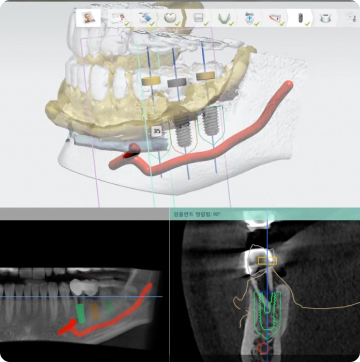
At EROM Dental, a 3D simulation is run for every implant placement
Rather than simply placing implants, in a planned position
We use a guide with the aim of placing the implant precisely.

Guided Implant
When Needed

  • When many implants must be placed at once
  • When the bone is in good condition but you are worried about bleeding
  • When you are afraid of incisions
  • When you have a systemic condition such as diabetes or high blood pressure

Advantages of Guided Implants

Guided Implant
Treatment Process

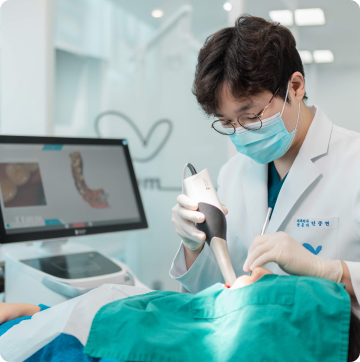
Using a scanner,
Precisely mapping the oral structure

Before the procedure, where the prosthesis will be placed
Identifying the position and planning the procedure

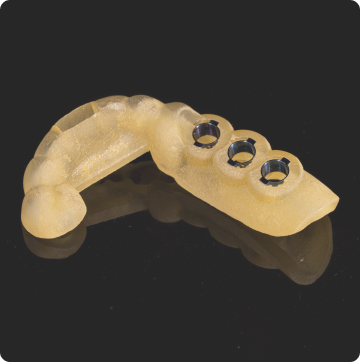
Using a precision 3D printer,
Making a guide customized to the patient

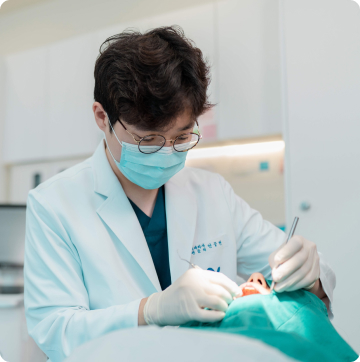
Using a surgical guide device,
Implant placement based on a simulated surgery

FAQ

Guided Implant: Common Questions

What is a guided implant?

A method in which the placement position and angle are planned in advance from low-dose 3D CT images of the bone and nerve canal, and the implant is placed using a surgical guide made according to that plan.

How is a guided implant different from a conventional implant?

With conventional implants, the placement position is determined during surgery based on experience, whereas a guided implant fixes the position and angle planned in advance on CT images with a guide device.

How is the guide made?

EROM Dental has 3D printers (Flashforge Focus 8.9 · Zenith D · Zenith L · Bambu Lab X1C Carbon), so we can make surgical guides matched to the planned implant position.

Might a guided implant also need a bone graft?

Yes. If the bone is narrower than about 8 mm for a molar (5 mm fixture + 1.5 mm of alveolar bone on each side), a bone graft is also needed with a guided implant.

Is a guided implant possible in every case?

In cases such as when initial stability is hard to achieve or when structures that must not be touched, like the nerve canal or maxillary sinus, are close by, even a guided implant may be difficult, so we confirm feasibility with a CT scan in advance.

Can immediate placement be combined with a guided implant?

Depending on the bone condition, guided planning and immediate placement can be done together. However, if we judge that initial stability will be hard to achieve, we recommend a different timing instead.

Which fixtures are used for guided implants?

We choose among Dentis SQ·AXEL, MegaGen BD and Straumann BLT·BLX according to your condition, with MegaGen BD and Straumann BLT as our main systems.

How much does a guided implant cost?

It varies by dentist and fixture type, starting from KRW 1,090,000 with Dentis SQ·AXEL. The cost of making the guide is also explained at consultation.

Is there a warranty on guided implants?

As with our other implants, the fixture is warranted for 5 years and the abutment and crown for 2 years, with a check-up required every 6 months.

What tests are done before a guided implant?

We check the bone, nerve canal and maxillary sinus with a low-dose 3D CT, plan the placement and make a guide to match.

Is a guided implant less painful?

Pain is closely related to the extent of incision and flap elevation. Placing the implant in the position planned with a guide can help reduce unnecessary tissue damage, but it varies with your bone and gum condition.

I need several implants—does a guide help?

When several implants must be placed at once, the placement order and angles can be planned in advance with CT images, which we use throughout the process.

Where is the prosthesis made after a guided implant?

Prostheses are made in our in-house dental lab, and the Chief Director personally checks and adjusts the design.

How does a guided implant consultation work?

We check your bone with a CT scan and plan the placement, then explain the expected cost and how treatment will proceed.

What should I be careful about after guided implant surgery?

Apply ice packs for 2–3 days right after surgery and take all prescribed medication. Avoid putting pressure on the surgical site, drinking, smoking, strenuous exercise and saunas; swelling and bruising usually resolve within 3 weeks.

Does smoking affect guided implants too?

Yes. As with other implants, osseointegration failure caused by smoking is excluded from the warranty, so we recommend not smoking before and after surgery.

Always together.
EROM Community

We record and share the value of being together.