



People made better.
Patient-Led Cavity Treatment

Ahn Jung-hyun, Chief Director

Hello, I am Ahn Jung-hyun, Chief Director.

At EROM Dental, when a patient first visits, we photograph every tooth in the mouth. This is partly for our records, but mainly because we want patients to see everything with their own eyes. You need to know your current situation to make decisions about treatment. Even cavities of similar size can sometimes be treated simply with resin, while others may need a crown. If we do not give patients clear criteria for this, they undergo treatment without truly understanding it, which leads to anxiety and dissatisfaction. That is why I show patients their whole situation in photos and then present my criteria and diagnosis together.

Example of patient-led cavity treatment
Our Commitment to Cavity Treatment

01

An experienced Chief Director

02

Checking cavities with intraoral photos

03

Precise Primescan

04

Designed by the Chief Director

05

One-Day Prosthetic Treatment

06

Personalized One-to-One Cavity Treatment

FAQ

Common questions before cavity treatment

What does patient-led cavity treatment mean?

A care approach that helps you choose treatment that fits your values based on sufficient information. At your first visit, EROM Dental Clinic photographs all your teeth, shows you your current condition in the photos, and explains the Chief Director's diagnostic criteria. The goal is for you to choose treatment knowing what the judgment was based on.

Why is treatment different for cavities of similar size?

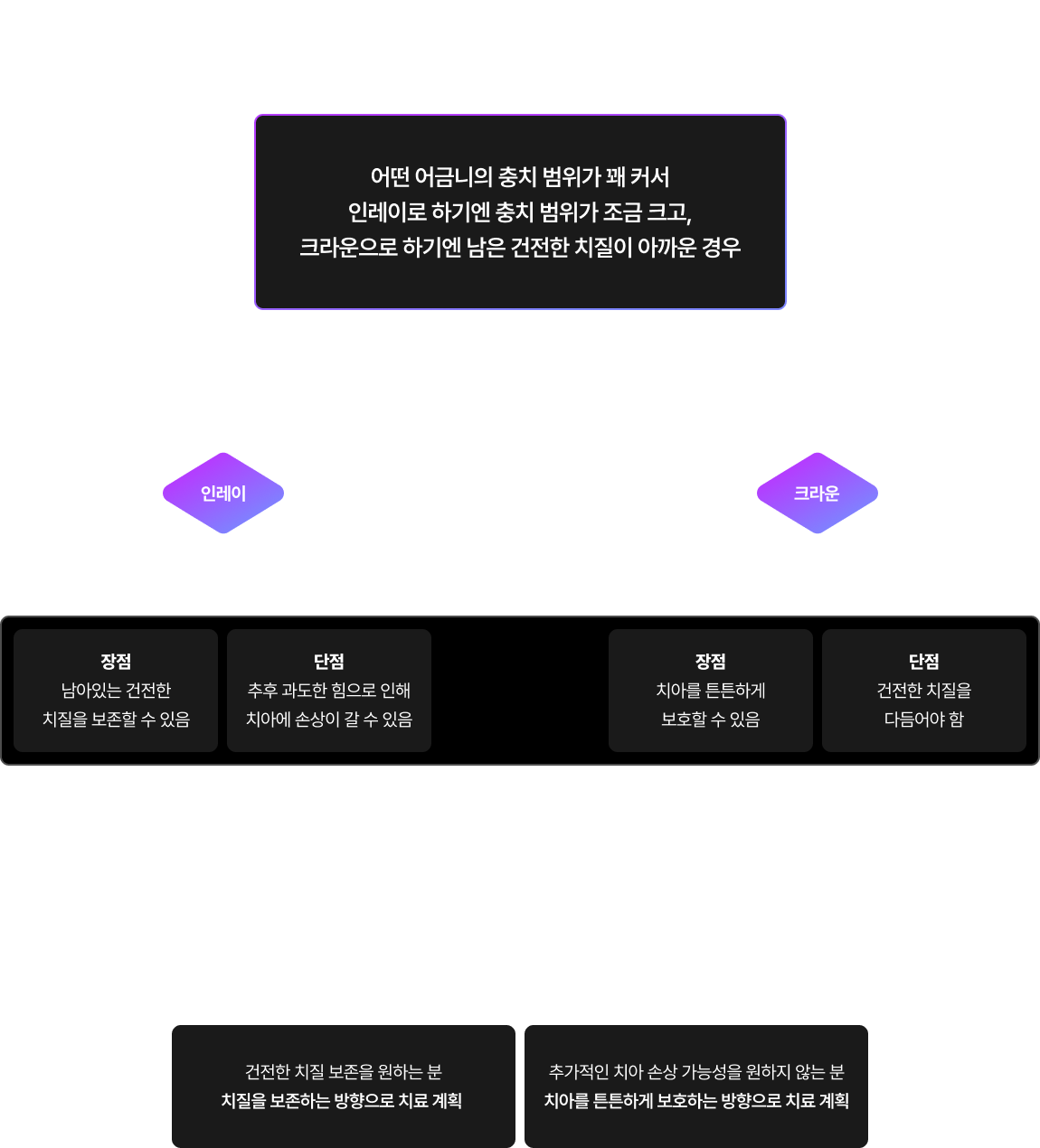
Even when cavities are similar in size, the treatment needed varies with location, depth and the direction of chewing forces. Some can be finished simply with resin, but if the damage is extensive or has spread to the edge of the chewing surface, a prosthesis such as a crown may be needed. We first show you these criteria in photos and then explain.

What tests are done before cavity treatment?

We take photos of all your teeth and scan them precisely with the CEREC Primescan to check the extent of decay. When needed, we use Q-ray to check for secondary decay around restorations or crack progression before explaining the treatment plan.

When would I have a Q-ray exam?

Q-ray is not taken routinely for every patient; we use it when needed for diagnosis—for example, when secondary decay is suspected around a restoration, when we need to check how far a crack has progressed, or when there are symptoms but no crack is visible to the eye.

If a cavity doesn't hurt, can I put off treatment?

If left alone because it doesn't hurt, inflammation can worsen so that neighboring teeth must also be extracted, or follow-up treatment such as implants can become difficult. If the tooth can recover, it is right to delay extraction as long as possible with treatment, but if it cannot improve, treating it without delay is better for future treatment as well.

Does cavity treatment hurt?

Most dental treatment is done under anesthesia, so once it takes effect you will not feel much pain during the rest of the procedure. The injection itself may hurt, but only for a moment, and afterward you can be treated comfortably.

If a cavity gets deeper, will I need root canal treatment?

Root canal treatment is needed when there is a risk of exposing the nerve while removing decay or when the nerve is already inflamed. Conversely, at an early stage where the nerve only reacts sensitively to stimulation, the tooth can sometimes be saved with restorative treatment alone. We advise you after reviewing the test results.

Do you use ceramic materials for cavity treatment too?

When the damage is too large to fill with resin alone, we use ceramic adhesive restorations such as inlays, onlays and overlays. This method precisely repairs only the damaged part with a material that bonds strongly to the tooth, and it is the area of care the Chief Director is most interested in.

Who checks the prosthesis design?

The Chief Director personally checks and adjusts what our in-house lab technician designs. With the lab in our clinic, we don't just receive a finished product—we can make adjustments during production.

Can cavity treatment be finished on the same day?

It depends on how far the decay has progressed. Resin fillings are often finished on the spot, and even inlays or crowns that require impressions and fabrication can sometimes be finished the same day because we make them in our in-house lab. However, onlays and overlays take a little longer to make, so same-day treatment may be difficult if your schedule is tight.

Can I get cavity treatment without an appointment on weekdays?

On weekdays from 2 PM to 4 PM, we offer walk-in hours when you can be seen right away without an appointment. Office workers and others short on time can use this time for a cavity treatment consultation.

How can I find out the cost of cavity treatment?

The cost depends on the size of the cavity and the materials needed, so we give you the exact amount at consultation after examination. Fees for major non-covered items such as inlays, onlays, overlays and crowns can be found on our Non-Covered Treatment Fees page.

Does the Chief Director personally perform cavity treatment?

Yes. Natural tooth preservation, including cavity treatment, is handled by Chief Director Ahn Jung-hyun (2nd generation). Some treatments, such as lingual frenectomy, are performed separately by Dentist Ahn Hong-heon (1st generation).

My cavity is severe and needs a crown—can it be done without root canal treatment?

It depends on the condition of the nerve. At the stage where pain occurs only with stimulation, early restorative treatment such as a crown or overlay can often finish things without root canal treatment. Conversely, if the tooth hurts even at rest or the pain lingers, root canal treatment is needed first.

How can I prevent cavities?

The basics are regular check-ups and scaling to manage the plaque and tartar that cause cavities. We recommend check-ups every 6 months, and at each one we compare intraoral photos with you to see whether anything has changed.

Is the national health screening (oral screening) linked to cavity treatment?

Yes. EROM Dental Clinic is an oral screening institution designated by the National Health Insurance Service and provides oral screenings for adults, students, and infants and children. If a cavity is found during screening, we explain a treatment plan through a follow-up consultation.

How should I care for my teeth after cavity treatment?

Even on treated areas, brush at least three times a day with the correct method, ideally right after eating. After treatment, regular check-ups also let us confirm together that no new cavities are forming elsewhere.

Can I follow cavity treatment that needs a prosthesis through EROM Live?

Yes. EROM Live is a service that lets you see the scanning, design, milling, sintering and glazing steps yourself, and it applies to the prostheses made in our in-house lab (MINISH excluded).

Always together.
EROM Community

We record and share the value of being together.