


People made better.
All on 6

What Is All on 6?

When periodontitis is severe and the jawbone is very insufficient,
placing only 4 implants is insufficient and they cannot do their job.
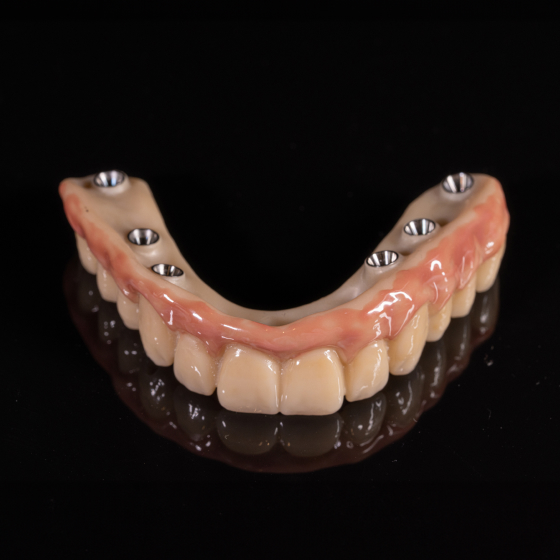
In such cases, through precise diagnosis with 3D CT and an intraoral scanner,
selecting areas where the jawbone is relatively healthy and increasing the number of implants to 6,
and distributing them to make and fit a full-arch prosthesis,
It adds more points to distribute the load.

FAQ

Questions often asked by people considering All on 6

What kind of treatment is All on 6?

A form of All on X that uses 6 implants in planned positions to restore the entire upper or lower jaw. With more implants than All on 4, it is an option that can provide more support depending on the bone condition.

How many implants does All on 6 use?

As the name suggests, it uses 6 implants. The exact placement positions and distribution are decided after an examination of your jawbone.

How is All on 6 different from All on 4?

The number of implants used differs: All on 6 uses 6 and All on 4 uses 4. Which is right for you is decided through examination and consultation, considering the amount and location of remaining bone and your bite force.

When is All on 6 considered?

It is considered when few teeth remain and we judge that a little more support than 4 implants is needed. Suitability is judged after an examination of your bone.

Are there cases where you do not recommend All on 6?

Yes. The cases in which we do not recommend All on X, including All on 6, are the same as those in which we do not recommend implant surgery itself. We do not recommend it for heavy smokers or drinkers, or for people with severe diabetes whose general health is not suitable for surgery.

Does All on 6 also require a bone graft?

If there is enough bone, it can be done without a graft; if not, a bone graft is needed. Compared with placing several implants, All on 6 also often involves a smaller surgical area and less bone grafting.

Is All on 6 more stable than All on 4?

It is true that more implants means more points to share the load, but which is more suitable depends on the amount and location of remaining bone and your bite force. We decide together after reviewing the test results.

Can older patients have All on 6?

Yes. Compared with placing many implants, it often involves a smaller surgical area and less bone grafting, which can be advantageous for older patients or those with systemic conditions. Whether surgery is possible is decided in a consultation that checks your general health.

Which implant fixtures are used for All on 6?

We choose among Dentis (SQ·AXEL), MegaGen (BD) and Straumann (BLT·BLX), with MegaGen BD and Straumann BLT as our main systems. Which fixture suits you is decided through examination and consultation.

Are All on 6 prostheses also made in your in-house lab?

Yes. It is made in our in-house lab; the technician designs it, and the Chief Director personally checks and adjusts it. You can follow the production progress through EROM Live.

What is the warranty period for All on 6 implants?

The fixture is warranted for 5 years and the abutment and crown for 2 years. Conditions: a check-up every 6 months; damage caused by the patient is repaired at cost; osseointegration failure caused by smoking is excluded from the warranty.

Is All on 6 surgery very painful?

Pain and swelling after surgery depend on how much the periosteum is affected by incision and flap elevation. More implants does not necessarily mean more pain; the extent of surgery and whether a bone graft is done have a greater effect.

How does an All on 6 consultation work?

In line with our patient-led approach, we show and explain the condition of your teeth and jawbone using photos, X-rays and, when needed, Q-ray. Your consultation is led by Chief Director Ahn Jung-hyun (2nd generation).

How much does All on 6 treatment cost?

Because it uses more implants than All on 4, the cost varies with the type of fixture and test results. The exact cost is explained in consultation after an examination of your jawbone.

Is All on 6 also done in a patient-led way?

Yes. Patient-led care helps you choose treatment that fits your values based on sufficient information, and All on 6 follows the same approach. We explain the diagnosis, the reasons and the alternatives before you decide.

Which is better: All on 6 or placing several conventional implants?

When few teeth remain, we compare placing many implants with placing fewer and going with All on 6. Which is better depends on your remaining bone and general health, so we decide together after examination.

Always together.
EROM Community

We record and share the value of being together.